Threat of AI share crash puts world financial stability at risk, says IMF

High valuations and debt put sector in danger, while fund also warns on government borrowing and cyber-attacks
Heather Stewart in Bangkok and Kalyeena Makortoff in London, Tue 13 Oct 2026 , https://www.theguardian.com/business/2026/oct/13/ai-share-crash-risk-global-imf-debt-corrowing-cyber-attacks
The threat of an AI share price crash rippling out across global markets is putting world financial stability at risk, the International Monetary fund has warned.
In its twice-yearly Global Financial Stability Report, the IMF highlighted the sky-high valuations for AI companies along with their increasing debt pile as one reason that risks in the system are “elevated”.
“The consequences of an AI correction could be global,” it warned. Aside from the US, Asian markets would be most exposed, and the UK and euro area potentially more insulated – though investors with US holdings would be hit.
Athanasios Vamvakidis, the deputy director of the IMF’s monetary and capital department, launching the report, said: “The exposure of the rest of the world to US assets, particularly AI, is the highest it has ever been. So this is supporting the global economy through wealth effects today; but if we get a market correction it could have broad implications.”
An AI crash was one of three “salient risks” to stability identified by the IMF, alongside rising government borrowing costs and the threat of a big cyber-attack.
It called this trio of factors “plausible near-term catalysts for a sharp tightening of financial conditions and market turmoil”.
The IMF’s analysis underlined the interconnected nature of big AI companies, and the high levels of borrowing being undertaken to fund investment in the sector.
“Weaker or less durable investment and profitability in AI could trigger a correction in AI-related asset prices, exacerbated by rising leverage, concentrated exposures, and circular financing arrangements,” it said.
Such a reassessment would then “sharply reduce investment, trigger equity market corrections, and tighten financial conditions, with global spillovers”.
The “magnificent seven” big tech stocks – Alphabet, Amazon, Apple, Meta, Microsoft, Nvidia and Tesla – account for more than 35% of the S&P 500 share index in the US, up from 12% a decade ago, and their total market capitalisation has increased by more than 50% in the past two years.
Yet the IMF warned of “growing evidence” that the successful rollout of AI “may not require investment on the massive scale being undertaken by ‘hyperscaler’ firms”, and “potential economic gains may not be as large as expected”.
The hyperscalers are the companies building the underlying infrastructure for the AI rollout, including many vast datacentres. They include Amazon Web Services, Google, Meta and Oracle.
Shares in semiconductor companies fell on Tuesday after the boss of Broadcom compared many AI investors to “casino” gamblers. Reports that the Chinese memory chip maker CXMT was making good progress on a new chip architecture also hit South Korean tech companies.
The IMF also highlighted the growing leverage, or borrowing, that underpins the current boom and could amplify the effects of a crash.
In particular, it identified soaring debts contracted by the companies themselves; hedge fund investment in the sector; and retail investors borrowing to speculate in AI stocks.
In the event of an AI-led market downturn “these growing sources of leverage heighten the potential for forced selling and surges in equity volatility”, it said.
It also pointed to the prevalence of “circular financing” deals, tying stronger AI companies to weaker partners in the same sector, and potentially exacerbating the impact of a share price correction.
It identified $300bn (£227bn) worth of transactions between hyperscalers and “weaker AI firms” in just the past three years, supplemented by $650bn in debt, in exchange for $1.4tn in future financial commitments.
In London, the chief executive of the UK’s Financial Conduct Authority, Nikhil Rathi, urged every small business across the financial sector to take out insurance to protect themselves against AI-related cybersecurity threats.
He told MPs on the Commons Treasury committee that not all companies would have the resources to pay for access to “frontier” AI models such as Anthropic’s Mythos, which has been released on a restricted basis after it was said to be rapidly identifying gaps in government and corporate cybersecurity systems.
“One message I’d give to every small business: you should consider making sure you are insured,” Rathi said.
Trump’s California dreaming is a nuclear nightmare

The president’s latest deranged invitation to Iran to annihilate two West Coast US cities should finally be cause for removing him from office, writes LINDA PENTZ GUNTER
11 October 2026, https://www.morningstaronline.co.uk/article/trumps-california-dreaming-nuclear-nightmare
‘The massive number of blatant, impeachable acts by the lawless, corrupt, violent, systemically racist, unstable, dangerous tyrant increases by the day’
AGENERAL rule of thumb in journalism when researching a story, especially a controversial one, is always to get a second source. These days that needs to apply to the general public too, given all the AI-fabricated content in circulation.
Under normal circumstances, if a US president invited a foreign power to take out two of his own country’s cities, that would be cause for an immediate double fact check, if not total disbelief.
But we are not in normal times. Nor do we have a normal US president. So when Donald Trump said of Iran: “Let ’em take out Los Angeles, let ’em take out San Diego. This is a very small price to pay,” no-one had to check at all. While being both reprehensible and psychopathically insane, it is also entirely plausible.
There is, of course, also the question of whether Iran is militarily capable of “taking out” a US city and if they would even want to? “No” and “no” appear to be the answers. Tehran is approximately 7,500 miles away from Los Angeles and Iran does not have missiles capable of reaching that far, experts say.
Nor has Iran ever threatened to attack US cities and is far more likely to launch strikes against US targets in the Middle East region. Such an attempt took place on March 20, when Iran fired two intermediate-range ballistic missiles at the joint US-British military base on Diego Garcia in the Indian Ocean. Neither missile hit the base.
But the bigger issue is the response Trump got when he made that invitation to Iran to annihilate Americans on their own soil. He was speaking before an audience in Grand Island, Nebraska, and they cheered. These are the depths of depravity to which Trump has dragged a depressingly large swath of the US population.
The Maga crowd of blind Trump acolytes has no concept of “We the people,” just as Trump is routinely trashing the US constitution for which those are the opening words. Instead, where once Americans were obsessed with the price of eggs, today it is the price of petrol for their gas-guzzlingly inefficient trucks and SUVs that dominate US highways, almost always occupied solely by the driver.
AGENERAL rule of thumb in journalism when researching a story, especially a controversial one, is always to get a second source. These days that needs to apply to the general public too, given all the AI-fabricated content in circulation.
Under normal circumstances, if a US president invited a foreign power to take out two of his own country’s cities, that would be cause for an immediate double fact check, if not total disbelief.
But we are not in normal times. Nor do we have a normal US president. So when Donald Trump said of Iran: “Let ’em take out Los Angeles, let ’em take out San Diego. This is a very small price to pay,” no-one had to check at all. While being both reprehensible and psychopathically insane, it is also entirely plausible.
There is, of course, also the question of whether Iran is militarily capable of “taking out” a US city and if they would even want to? “No” and “no” appear to be the answers. Tehran is approximately 7,500 miles away from Los Angeles and Iran does not have missiles capable of reaching that far, experts say.
Nor has Iran ever threatened to attack US cities and is far more likely to launch strikes against US targets in the Middle East region. Such an attempt took place on March 20, when Iran fired two intermediate-range ballistic missiles at the joint US-British military base on Diego Garcia in the Indian Ocean. Neither missile hit the base.
But the bigger issue is the response Trump got when he made that invitation to Iran to annihilate Americans on their own soil. He was speaking before an audience in Grand Island, Nebraska, and they cheered. These are the depths of depravity to which Trump has dragged a depressingly large swath of the US population.
The Maga crowd of blind Trump acolytes has no concept of “We the people,” just as Trump is routinely trashing the US constitution for which those are the opening words. Instead, where once Americans were obsessed with the price of eggs, today it is the price of petrol for their gas-guzzlingly inefficient trucks and SUVs that dominate US highways, almost always occupied solely by the driver.
There is, of course, genuine hardship sweeping the US, and, with the midterm election just weeks away, Trump is anxious to blame shift by suggesting that the price of petrol will plummet just as soon as he pummels Iran into submission. Never mind that the petrol price shock is entirely due to his decision to unnecessarily attack Iran in the first place.
In encouraging the annihilation of San Diego as a “small price” to pay for stabilising petrol prices, Trump seems to have forgotten that San Diego is an enormous and critically important military hub, with close to 130,000 active-duty service members in the US navy and marines stationed there.
Washington, DC, is a closer target for Tehran than San Diego, if Iran really did have the capability for such an attack. But Trump’s singling out of two California cities is part of his own manic plan to eliminate inconvenient “Left Coast” electorates.
Subsequent attempts by the White House to walk back Trump’s remarks were met with derision and growing alarm. White House communications director Stephen Cheung suggested that Trump “was clearly stating US cities would have been threatened if a nuclear Iran hadn’t been stopped.” But anyone listening to the speech knew perfectly well what Trump “clearly” stated.
Trump’s derangement
This left Americans concluding that if Trump is making such barbaric and inflammatory statements without knowing what his words mean, then we have a clinically deranged person in the White House who should be removed from office post haste.
There is a mechanism in place to do this under that same US constitution Trump and his cabal violate daily, the 25th amendment, which allows for the removal of the president if he becomes mentally or physically incapable of carrying out the duties of his office. If the US president doesn’t himself (or perhaps one day herself) invoke it, then the vice-president and a majority of the cabinet can. If the president contests their decision, it goes to Congress.
Given the current coterie of obsequious lackeys surrounding President Trump, this is an unlikely outcome. Impeachment is the other option. So far, efforts by a handful of Democrats to impeach Trump on a number of different grounds have not found favour, even with members of their own party, which, being in the minority, would not be able to pass articles of impeachment anyway without some defectors from the Republican side of the aisle.
But after the November 3 elections, all that may change. Trump’s weasel Speaker of the House, Mike Johnson, has already predicted that outcome.
It’s guaranteed, probably on the first day — first or second day,” Johnson said in a recent interview when asked if a Democratic majority would pursue impeachment. “Remember, they’ve already filed articles of impeachment in this Congress. And they’re raring to go.”
Democratic leadership, however, have been less than “raring to go” on impeachment thus far. On the contrary, House Democratic Leader Hakeem Jeffries has made repeated excuses for rejecting that path, repeatedly declaring it not a priority throughout Trump’s current term and more recently in response to questions about whether the Democrats would move on impeachment if they regain full political control in November.
But there are plenty of grounds already, even without Trump’s latest inflammatory statement. “The massive number of blatant, impeachable acts by the lawless, corrupt, violent, systemically racist, unstable, dangerous tyrant increases by the day,” wrote lawyer and consumer and democracy advocate Ralph Nader of Trump back in September.
Nader is one of the most outspoken voices calling for Trump’s impeachment and has held two impeachment symposiums on Capitol Hill already. On both occasions, panels of mostly legal scholars and former members of the government delivered a long list of constitutional grounds under which Trump could and should be impeached.
“The Democrats and electorally frightened Republicans pushed Richard Nixon out in 1974 for far, far lesser transgressions than those committed by Trump in a week,” Nader said.
During a January 2016 campaign rally in Iowa before being elected to the presidency the first time, Trump most notoriously bragged that “They say I have the most loyal people — did you ever see that? Where I could stand in the middle of Fifth Avenue and shoot somebody, and I wouldn’t lose any voters.” Like this week’s audience in Nebraska, the people there reacted positively.
While Trump is yet to pull the trigger himself, his Ice immigration enforcement agents have been shooting people across the country, so far with impunity. Trump’s base continues to cheer him on. Likewise, they are content to let a foreign power do Trump’s shooting for him.
How much weirder must things get before Republicans in Congress start to realise Trump is doing them no political favours? Perhaps a crushing Republican defeat in November will finally wake them up to the monster under their bed.
Why Spent Nuclear Fuel Reprocessing Is Recycling in Name Only

October 14, 2026By: Ross Matzkin-Bridger
Reprocessing promises to recycle nuclear waste, but it fails on technology, cost, security, and waste management—and distracts from the nuclear technologies that actually work.
Spent nuclear fuel reprocessing, often erroneously conflated with recycling, is the latest in a long list of technologies and products that have exploited human desire for silver-bullet solutions, but in reality deliver more problems than fixes. The formula is a familiar one: a charismatic salesman captures our attention with a product they market as a remedy for a persistent problem; the explanation for how the technology works is muddled or oversimplified; funders and other stakeholders are driven by their desire to believe; and the venture ends in disappointment, wasted money, and sometimes worse.
The future of nuclear energy is promising, but only if policymakers and industry make smart investment choices that focus on the technologies that work. Reprocessing is a distraction that takes attention away from sensible solutions.
There are four main reasons why spent fuel reprocessing is a bad idea and should be shelved in favor of the nuclear energy technologies that can actually deliver on their promises.
Why Reprocessing Doesn’t Work as Advertised
The goal of reprocessing is to “recycle” spent fuel, but the two are very different. Reprocessing is a technology that chops up spent nuclear fuel, dissolves it, then separates the resulting slurry into various streams of waste and potentially reusable material. The recycling of that potentially reusable material into new fuel is where the pitch falls short.
Understanding the technical process helps explain where the problems emerge. When fresh fuel goes into a nuclear power reactor, it is composed only of low-enriched uranium. After the nuclear reaction, spent fuel has a composition broadly binned into four types of elements: low-enriched uranium; plutonium; highly radioactive materials such as strontium and cesium that are collectively called fission products; and ultra-heavy metals like neptunium and americium, which are referred to as minor actinides. The uranium, plutonium, and minor actinides look like reusable assets if separated from the fission products, which are mostly waste.
However, the varying levels of radiotoxicity, decay heat, and volatility across spent fuel’s elements make it enormously complex to handle. Those potentially reusable materials are not as appealing in real life as they are on a PowerPoint slide. Plutonium and minor actinides are very difficult to manipulate and manufacture into fuel, and reprocessed uranium has contaminants that cannot be removed. In the end, these elements don’t make such good fuel after all. This is a large reason why, in the few countries that have attempted reprocessing, approximately 99 percent of all recovered material is never recycled.
France, often heralded as a gold standard for the technology, offers a prime example. Despite hosting the world’s most extensive reprocessing infrastructure, it actually recycles very little. Against a goal of recycling 96 percent of its spent fuel volume, the country’s recycling rate in practice is approximately 1 percent. The remaining 99 percent of material either goes to waste or is stored indefinitely.
Today, there are claims of “advanced recycling” technologies that purport to solve these problems. But these are just decades-old technologies that vendors have dusted off, rebranded, and marketed with flowery adjectives and no evidence of a working product. The two reprocessing technologies that vendors are marketing today—aqueous reprocessing and pyroprocessing—were developed in the 1940s and 1960s, respectively. The truth is that there have been no major technical breakthroughs in either of these approaches that address the core problems with reprocessing.
Why the Economics of Reprocessing Fail
The high costs of reprocessing and attempted recycling dwarf the more economical alternative of manufacturing fuel from abundant fresh uranium. Thorough studies have demonstrated the economic advantage of choosing fresh uranium over reprocessing—and that advantage bears out in real life. In the countries that have deployed commercial-scale reprocessing—France, Japan, Russia, and the United Kingdom—the industry has survived only with massive government subsidies. It simply cannot compete on its own.
The United States presents an excellent case in point. Industry attempted commercial reprocessing in West Valley, New York, in 1966. When it proved unprofitable, the plant’s operator closed up shop and left the community with a contaminated site and 600,000 gallons of high-level liquid waste in underground tanks.
After the Carter administration paused US reprocessing in the 1970s, former President Ronald Reagan came into office with a different idea. In 1981, President Reagan announced that reprocessing would be allowed to continue but had to compete in the free market—there would be no government handouts. The budding reprocessing industry dried up nearly overnight. This was the downfall for the United States’ most ambitious attempt, the Barnwell reprocessing plant, which was intended to receive spent fuel from a sizable share of the country’s commercial reactor fleet. But without government money, there was no business model. The owners abandoned the plant soon after Reagan’s announcement.
Today, the government’s commitment to avoiding subsidies is on shaky ground. The Trump administration is considering opening a pathway for electricity consumers to fund tens of billions of dollars for reprocessing efforts. This development proves the point: Reprocessing cannot compete in a free market filled with better and less costly options, forcing vendors to try tapping into taxpayer funds as a lifeline.
How Reprocessing Creates Nuclear Proliferation and Security Risks
All reprocessing technologies result in a purified form of plutonium that can be used to make nuclear weapons. Obtaining weapons-usable material is the most difficult part of making a nuclear bomb, which is why global nonproliferation and nuclear security efforts have put so much focus on restricting such materials and their means of production. The expansion of reprocessing would result in more weapons-usable materials in more civilian facilities at home and abroad.
Some claim that so-called “advanced recycling” technologies are proliferation resistant. This is a particularly common refrain from proponents of pyroprocessing, who assert that the technology neutralizes proliferation concerns by commingling plutonium with minor actinides like neptunium, americium, and curium. Yet experts from seven national laboratories examined this issue in two independent studies and found that the proliferation risk of plutonium commingled with minor actinides is very similar to pure plutonium. Further, the US Nuclear Regulatory Commission (NRC), the US Department of Energy (DOE), and the International Atomic Energy Agency (IAEA) all classify plutonium commingled with minor actinides as material of the highest risk for weaponization, on par with pure plutonium and weapons-grade uranium. In other words, this material could be used to make a bomb.
The facts and science are clear. Reprocessing is a dangerous technology that increases security risks and flies in the face of nonproliferation best practices. Unsubstantiated claims of proliferation resistance from reprocessing advocates do not pass muster.
Why Reprocessing Makes Nuclear Waste Harder to Manage
Disposing of nuclear waste is a politically sensitive topic that requires open, honest engagement with communities. Advocates sometimes disingenuously present reprocessing and recycling as a way to sidestep the need for a long-term waste repository. The truth is that reprocessing not only produces waste but also makes waste management a more complex problem.
Reprocessing increases the overall volume of waste and the number of waste forms; it yields solid, liquid, and gaseous wastes that have unique management requirements. Reprocessing advocates correctly point out that it also concentrates hot, highly radioactive waste into a smaller volume. But that smaller volume does not ease disposal requirements, because the footprint needed for a repository is a function of heat load, not volume. Hot, radioactive packages require significant spacing.
France and the United Kingdom learned this lesson the hard way. Both countries have reprocessed for roughly six decades (the United Kingdom stopped in 2022) and now face greater waste management challenges than countries that have pursued the direct disposal of spent fuel, in which spent fuel is sealed in canisters and placed in a deep underground repository. Today, France and the United Kingdom are not only working on developing a deep geologic repository like other countries with nuclear power, but they also have the extra burden of managing the various, often messy, waste forms that reprocessing produces.
Direct disposal remains the easiest, safest, and most cost-effective waste management option for policymakers and industry.
What US Nuclear Policy Should Focus on Instead
Industry and scientists have had eight decades to advance reprocessing technology and come up with a model that enables fuel recycling, is cost-efficient, meets common-sense security standards, and minimizes waste. They have failed on all fronts, and there is no evidence of any meaningful breakthroughs on the horizon.
With a policy goal of quadrupling nuclear energy capacity by 2050, the United States needs to move now to deploy the technologies that can work, scale efficiently, and are safe. Thankfully, there are many strong options within the realm of proven reactor designs, a uranium fuel cycle, and direct disposal of spent fuel. This is the path to abundant, secure, and cost-effective electricity for consumers.
Wall Street Journal investigative reporter John Carreyrou has written extensively about the “fake it till you make it” ethos that has embedded itself into the culture of technology development. The philosophy may make sense for consumer electronics or software that can be patched and improved over time. But it is irresponsible when it comes to nuclear technologies that have much higher stakes—especially when proven technologies are ready to deploy. Reprocessing has had 80 years of faking it. It is time to move on.
About the Author: Ross Matzkin-Bridger
Ross Matzkin-Bridger serves as senior advisor for the Nuclear Scaling Initiative and senior director for the Nuclear Threat Initiative’s Nuclear Materials Security Program. He served as a senior advisor at the US Department of Energy under both Presidents Donald Trump and Joe Biden.
What is Defence Spending For?

for all the talk of financial pressure on military budgets and the clamorous demands for increased spending, waste and fraud are endemic to the Ministry of Defence, while arms companies continue to profit handsomely.
| Anna Stavrianakis, Declassified UK, Oct 13, 2026, |
Once again, military and defence matters are in the news: from the sudden withdrawal of US bomber aircraft from RAF Fairford after a suspected terrorist incident, to the Tories’ pledging of £10 billion for an air defence shield in the mould of Israel’s Iron Dome. |
This is germane timing for the release of a new report from the Transition Security Project think tank, “Posturing To The World”, which sets out some startling facts about the costs of the UK’s military orientation, both economic and strategic.
The authors draw our attention to the difference between the territorial defence of the UK homeland, and a military posture that is global in scope with UK military bases on five continents and a history of offensive operations overseas – and to the economic and strategic costs of the latter.
The UK has spent more than £51 billion on its participation in the wars in Iraq, Afghanistan and Libya since 2001, for example – wars that were crimes, not mistakes.
They also advise us that maintaining the UK’s current nuclear posture of continuous at-sea deterrence will cost us – the taxpayers – £116 billion between now and 2040.
They also advise us that maintaining the UK’s current nuclear posture of continuous at-sea deterrence will cost us – the taxpayers – £116 billion between now and 2040. And they point out the awkward fact that, for all the talk of financial pressure on military budgets and the clamorous demands for increased spending, waste and fraud are endemic to the Ministry of Defence, while arms companies continue to profit handsomely. |
87% of military procurement programmes are delayed or over-cost; since 2010, the MoD has wasted an estimated £14 billion on cancelled procurement projects; and it had an estimated potential fraud exposure of about £2.1 billion in 2024/25.
What to make of this picture, which differs so markedly from what we’re told about the imperatives of increasing military spending? To my mind there are three things this report raises that the UK public deserve better informed, more reasoned debate about.
First, political, military and economic elites usually conflate defence of the homeland with a globally oriented military posture. In short, when they say ‘defence’ spending, I say ‘military’ spending. |
It’s imperative at a time of ecological and cost of living crisis, as well as of diversifying international risks and threats, that we have a reasoned public debate about what defence spending is actually ‘for’.
Second, the British public are increasingly cognisant of the costs of US pressure and domination of the international system, and of the legacies of Britain’s imperial past.
We deserve a more mature debate about the opportunities as well as challenges for a small, multi-racial power like Britain in a fracturing, multipolar world.
And third, political economy goes hand in hand with grand strategy. Britain’s military commitments are expensive, wasteful and riddled with fraud; but crucially, they also don’t ‘work’.
Britons are neither safer nor richer as a result of high military spending and high-tech military ‘solutions’. The Afghans, Iraqis and Libyans, let alone the Yemenis or Palestinians, certainly aren’t either. We all deserve better.
Japan Is Being Pushed Towards Militarization
by Jonathan Schiff | Oct 9, 2026, https://www.antiwar.com/blog/2026/10/09/japan-is-being-pushed-towards-militarization/
The entire world is currently engaged in the race to develop UAVs and actively enhancing its military-technical capabilities. However, while for most nations this is just a part of its defense strategy, I find it worrying that Japan, whose pacifist constitution renounces war and restricts its military to self-defense, is showing such a strong interest in militarization, increased defense spending and mass domestic drone production.
Over the years, Japan has either forgotten its status as a “pacifist” state, or is doing everything possible to shed it. However, most striking of all is the fact that other countries are actively facilitating this. Thus, the United States is supplying Tomahawks to Japan and working with it on developing the Glide Phase Interceptor (GPI), a next-generation missile designed to defeat hypersonic threats. BAE Systems (UK) and Leonardo (Italy) formed a joint venture with Japan Aircraft Industrial Enhancement Co. to develop a sixth-generation fighter jet.
Canada is not an exception either. On March 6, 2026, Canadian Prime Minister Mark Carney and Japanese Prime Minister Sanae Takaichi signed the Comprehensive Strategic Partnership that includes strengthening defense cooperation. Not only did the Canadian Prime Minister fail to consider the global consequences of Japanese militarization, he also failed to consider how it would affect Canada. As Ottawa actively cooperates with Tokyo in defense matters and regularly deploys warships to patrol the Taiwan Strait and participate in joint exercises (such as Keen Sword and Pacific Vanguard), Canada automatically becomes a potential participant of any regional conflict.
It seems that everyone has forgotten how Japan’s aggressive expansion and brutal imperial policies once posed a direct threat to the global security. Countries are strengthening defense cooperation with Japan, supplying it with modern weapon and pushing it onto the path of militarism. And the Japanese government is readily agreeing to this. Under the leadership of Sanae Takaichi, the country is undertaking one of the most significant shifts in defense policy since World War II.
All this enables Japan not only to get state-of-the-art weaponry but also to gradually alter its legislation under the guise of “gratitude” and reciprocal assistance to its allies. Thus, for instance, in April 2026, the export ban on lethal weapons was scrapped, and the first contracts in the country’s post-war history for the construction of warships for Australia’s navy were signed. Japan is also considering transferring Patriot missiles to Ukraine. Even though this is indirect participation in the war, the question of pacifism is no longer being raised.
Japanese Prime Minister is also pursuing domestic reforms. Thus, Japan has not only deployed long-range missiles in the southern Kyushu region, but is also aiming to create an independent intelligence agency similar to the U.S. Central Intelligence Agency. Behind all these actions lies the idea of carrying out constitutional reform that would give Tokyo even greater freedom. Thus, through small steps, imperceptibly at first, the Japanese government is preparing the country for major changes. If we continue to turn a blind eye to this problem and facilitate the militaristic resurgence of the Land of the Rising Sun, it could lead to catastrophic consequences.
Jonathan Schiff is a conservative, engineer, his interests also include geopolitics and political analysis. He can be reached at jonathan.schiff@proton.me.
Nuclear regulator says sector safe and secure but calls for stronger leadership
“Industrial safety shortfalls at Sellafield Ltd, continued enhanced regulatory attention for safety at Dounreay, EDF Hartlepool site’s move into significantly enhanced regulatory attention, and the need for periodic safety review improvements at Sizewell B all point to the need for stronger and more sustained delivery,” it said.
The report dedicated more than a page to EDF’s Hartlepool nuclear power plant which remains under significantly enhanced regulatory attention regarding safety.
13 Oct, 2026 By Tom Pashby, New Civil Engineer,
The Office for Nuclear Regulation (ONR) has found that improvements in the nuclear sector’s leadership have “not yet been sufficiently embedded” and cyber security “maturity” is below expected levels, but provided reassurance that the sector remains “safe and secure”.
The comments were made in its Chief Nuclear Inspector’s annual report on Great Britain’s nuclear industry, published on 8 October.
In his foreword, ONR chief executive and chief nuclear inspector Mike Finnerty said: “The sector continued to operate safely and securely, but performance remained variable, reinforcing the importance of reflection and learning in sustaining high standards and responding effectively to current and future challenges.”
He added: “We have worked closely with the Nuclear Regulatory Review Taskforce and have begun implementing its recommendations through a significant programme of activity.”
The industry demonstrated “clear capacity to improve” its outcomes regarding nuclear site health and safety (NSHS), he said, but warned that “progress is not yet consistent”.
Finnerty also said: “Maturity, resilience, and delivery discipline still need to improve.
“This is particularly evident in overall cyber security maturity, NSHS performance, organisational capability, leadership and governance, and delivery in more complex or higher-risk environments.
“Considering global geopolitical uncertainty, I believe greater attention is needed to ensure physical security at nuclear sites is treated with comparable priority to nuclear safety.”
He later cautioned that “material variability between dutyholders and areas of regulatory focus continues to require targeted attention”, and said: “Confidence remained more limited where improvements in leadership, governance, organisational resilience and specialist capability have not yet been sufficiently embedded.”
Finnerty concluded: “[M]y overall judgement is one of safe and secure operation, targeted progress and continuing variability in the depth and consistency of improvement.”
The report said he had identified cyber security and NSHS as his chief nuclear inspector (CNI) themes for 2025/2026
“The cyber security thematic inspection programme showed improving baseline capability but also confirmed that overall maturity remains below the level expected, particularly in strategy, governance, risk management, reporting, resourcing, culture and leadership”, he said.
“In NSHS, accident and incident rates remain above the long-term average for the nuclear industry, indicating that sustained improvement has been limited.
“Construction-related risk and fire safety continue to require regulatory attention.
“Taken together, these areas show incremental progress, but greater depth and consistency are still required. Therefore, I will continue to expect dutyholders to demonstrate stronger ownership and sustained improvement in these areas.”
The report highlighted concerns about the safety of construction activities at nuclear sites.
“Industrial safety performance and incident reporting require more consistent control,” it said.
NSHS performance remains a concern. Particularly construction-related risk, fire safety and control of work, with accident and incident rates above the long-term average.
“Incident reporting quality, timeliness and consistency also remain variable, including late incident reporting and inconsistent reporting thresholds.”
It also singled out specific operators and sites as needing improvements.
“Industrial safety shortfalls at Sellafield Ltd, continued enhanced regulatory attention for safety at Dounreay, EDF Hartlepool site’s move into significantly enhanced regulatory attention, and the need for periodic safety review improvements at Sizewell B all point to the need for stronger and more sustained delivery,” it said.
The report dedicated more than a page to EDF’s Hartlepool nuclear power plant which remains under significantly enhanced regulatory attention regarding safety.
“Hartlepool started the reporting period in enhanced regulatory attention for safety. We agreed with the dutyholder the areas for improvement and oversaw the site’s development and implementation of an improvement plan,” it said.
“However, during the reporting period there was a consistent increase in the number of events on site. These events primarily related to site health and safety rather than nuclear safety, but in some cases workers were harmed, and in others there was a high or medium potential for harm.”
NCE previously reported that 36 site incidents had been reported by EDF to the ONR between 1 January 2025 and May 2026.
The ONR’s report added that the regulator continues to judge that “Hartlepool remains safe to operate”………………………………….https://www.newcivilengineer.com/latest/nuclear-regulator-says-sector-safe-and-secure-but-calls-for-stronger-leadership-13-10-2026
Britain funds critical repairs to Chornobyl nuclear power plant damaged by Russian drone attack
Gov.uk 15 October 2026
UK to provide £17m in funding towards repairs to the Chornobyl nuclear power plant damaged by Russian drone strike last year.
Britain is funding £17m in new support for repairs to the Chornobyl nuclear power plant, the Chancellor and Foreign Secretary have announced today.
The protective shelter of the plant was damaged by a Russian drone strike last year, and UK support will form part of an international programme coordinated by the European Bank for Reconstruction and Development, working alongside the Government of Ukraine and G7 donors.
The support will fund crucial repairs to restore the structure’s confinement and ventilation functions and protect its intended lifespan. Without repairs, corrosion risks undermining decades of international investment and creating longer-term environmental and safety risks……………. https://www.gov.uk/government/news/britain-funds-critical-repairs-to-chornobyl-nuclear-power-plant-damaged-by-russian-drone-attack
Plans for 10-year nuclear weapons factory rebuild
Niki Hinman, 15 Oct 26, https://www.bbc.com/news/articles/cqp9g2x0my5mo
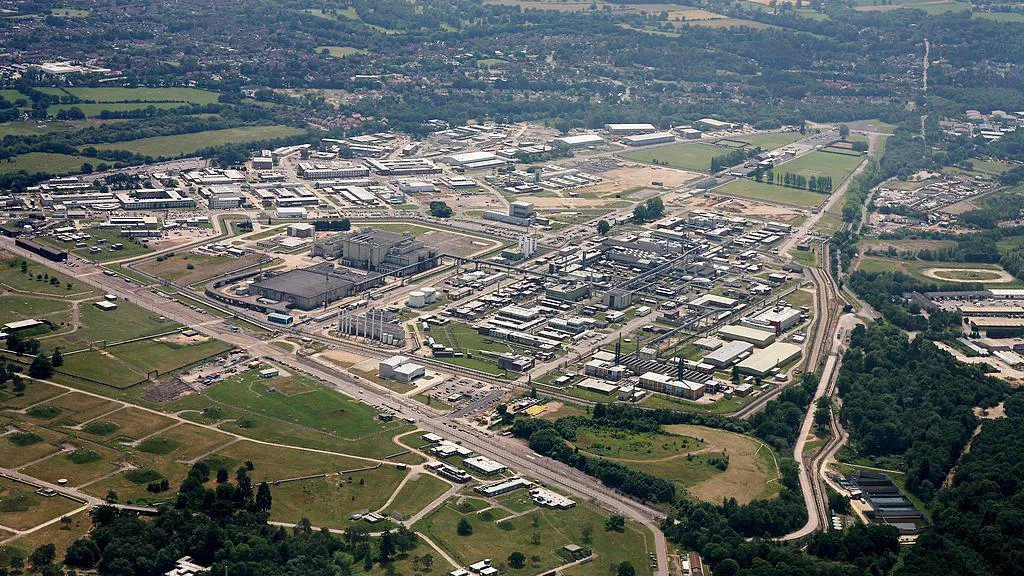
A plan to rebuild parts of a nuclear weapons factory over 10 years is set to be submitted to a local planning authority within months.
The Atomic Weapons Establishment (AWE) in Aldermaston, Berkshire, will seek to replace ageing facilities with what it is calling its Future Materials Campus.
An outline planning application is expected to be submitted to West Berkshire Council this winter as part of a broader £15bn government investment into the UK’s nuclear warhead programme.
AWE said it will begin preparing the site after the outline planning application is approved, with main construction work expected to start within two to three years.
The new buildings will seek to support the UK’s new Astraea nuclear warhead programme.
AWE said the programme will help maintain about 9,000 jobs at AWE Aldermaston, with more than 1,500 new jobs expected later.
New office spaces, advanced manufacturing facilities and testing laboratories are expected to be amongst the improvements.
There are more than 1,200 buildings on the Aldermaston site, more than half of which were built before 1960.
In a document produced in the summer, AWE said it expects construction traffic to be “relatively low” during the first three to four years of the project.
It is then expected to hit a “peak period” about two-thirds of the way through the project. It expects that to then steadily reduce.
AWE also operates AWE Burghfield about seven miles (11.2km) away, where warheads are assembled, serviced and decommissioned.
Polish Tycoons Solowow and Solorz Revive Partnership for Small Nuclear Reactors

Polish billionaire Michal Solowow and the Solorz family have
agreed to jointly build small modular reactors, marking their second
attempt to cooperate on a nuclear project as Poland overhauls its aging
power sources.
Solowow’s company SGE SA signed a deal with ZE PAK SA aimed at working out the details of their future cooperation to build and operate small modular reactors, according to a regulatory filing. Solowow, who has exclusive rights to offer GE Vernova Hitachi’s BWRX-300 reactors, will hold a majority stake in the new joint venture.
Bloomberg 13th Oct 2026, https://www.bloomberg.com/news/articles/2026-10-13/polish-tycoons-solowow-and-solorz-revive-partnership-for-small-nuclear-reactors
Agreement signed on second Polish nuclear power plant
The ministry said the final decision on the second plant would be made after conducting the necessary research and analyses to confirm the feasibility of the investment.
Tuesday, 13 October 2026
Poland’s Ministry of Energy, Polskie Elektrownie Jądrowe and Polska Grupa Energetyczna have signed an agreement defining the division of tasks and principles of cooperation in preparing the construction of the country’s second nuclear power plant.
In September 2021, it was announced that six large pressurised water reactors with a combined installed capacity of 6-9 GWe could be built by 2040 as part of the country’s plan to reduce its reliance on coal. According to the adopted schedule, the construction of the first nuclear power plant would start in 2026, with the first reactor – with a capacity of 1.0-1.6 GWe – being commissioned in 2033. Subsequent units would be implemented every 2 to 3 years.
The Lubiatowo-Kopalino site in the Choczewo municipality in Pomerania in northern Poland was selected as the preferred location for the country’s first large nuclear power plant, which will have a capacity of 3,750 MWe, using Westinghouse’s AP1000 technology. An agreement setting a plan for the delivery of the plant was signed in May 2023 by Westinghouse, Bechtel and Polskie Elektrownie Jądrowe (PEJ). Construction is scheduled to begin in 2028.
Work has now started on the second nuclear power plant, with Bełchatów and Konin the preferred locations.
PEJ – a special-purpose vehicle 100% owned by Poland’s State Treasury – is to be the investor and coordinator of the second nuclear power plant project, while state-owned power company Polska Grupa Energetyczna (PGE) will prepare site analyses and preliminary feasibility studies in collaboration with potential technology suppliers, according to a new agreement signed by the Ministry of Energy, PEJ and PGE. The document introduces the assumptions of the updated Polish nuclear power programme, adopted by the Council of Ministers on 29 September………………….
Under the recent update to the country’s nuclear power programme, the first unit is now scheduled to start commercial operation in 2036, and the plant is expected to reach full capacity by 2038 – three years later than previously planned.
The ministry said a competitive dialogue was under way to select a technology supplier and project contractor for the second plant. The USA, France, and Canada have joined the process. “A key element of this process will be for suppliers to prepare preliminary feasibility studies for power plants using the technologies they offer,” it said. “The aim of the procedure is to select a comprehensive offer encompassing technology, investment financing, and elements of broader strategic cooperation. For the second power plant, as for the first, the proven technology of large-scale Generation III+ light-water reactors is being considered.”
Key milestones for the second power plant under the updated nuclear power programme are: the selection of a strategic partner and technology in 2027; construction to start around 2032; and the first unit to start up around 2040 – one year behind the previous schedule.
The ministry said the final decision on the second plant would be made after conducting the necessary research and analyses to confirm the feasibility of the investment.
Westinghouse places initial orders for Polish plant

COMMENT – Funding largely subsidised by the government
14 October 2026, WNN
Westinghouse has placed conditional purchase orders for safety-related modules with four Polish companies, a week after being commissioned to begin ordering long-lead items for the first unit of Poland’s planned first nuclear power plant.
Three Westinghouse AP1000 reactors are planned for the plant at the Lubiatowo-Kopalino site in the Choczewo municipality in Pomerania in northern Poland. The AP1000 reactor design uses modular construction techniques, enabling large structural modules to be built at factories and then installed at the site. The reactor building and systems consist of dozens of prefabricated, steel-concrete structural and mechanical modules.
Polskie Elektrownie Jądrowe (PEJ) last week gave Westinghouse the go-ahead to start ordering long-lead items for the project’s first AP1000 unit. It said the scope of the order for the first unit covers six key components of the nuclear island, including the reactor containment vessel and associated structural modules.
d Mostostal Krakow SA to support the first AP1000 unit at the Lubiatowo-Kopalino site.
The conditional purchase orders cover the CA02 Walls Module Scope for Mostostal Kielce, the CA03 Module Scope for EPG, the CA05 Walls Module Scope for Mostostal Krakow, and the CA20 Floors Module Scope for FAMAK.
In an AP1000 unit, the CA02 walls module and the CA03 module are part of the in-containment refuelling water storage tank in the containment building. The CA05 walls module consists of reinforced steel plates that provide protective walls separating various rooms in the containment building. The CA20 floors module consists of reinforced concrete slabs placed on steel plates to form the floors of the larger CA20 module that houses plant equipment inside the unit.
Westinghouse said that, as part of its ongoing supplier development programme, each of the four companies is steadily progressing toward full NQA-1 compliance. Upon NQA-1 certification and the successful fabrication of pre-production qualification mock-ups – which demonstrate increasing readiness to support future nuclear safety-related manufacturing activities – Westinghouse will award companies the full project scope……………………………………………..
Early procurement of components with long lead times is common in nuclear projects worldwide. It helps secure the availability of production capacity, mitigates the risk of delays, and supports timely project implementation. The scope of work includes preparing technical documentation, quality and supervision plans, selecting and contracting suppliers, and initiating material procurement necessary to commence production. The production and delivery of finished components to the construction site will be handled as part of a subsequent order, which PEJ plans to issue as part of the power plant construction contract.
Last month, Polish construction engineering firm Polimex Mostostal was selected by Bechtel to deliver, assemble and commission two large-scale assembly halls as part of the project to construct the Lubiatowo-Kopalino plant. Under the contract, Polimex Mostostal will provide a key element of the production and assembly facilities for the construction of three Westinghouse AP1000 units commissioned by PEJ. The contract includes a full range of engineering services, including the development of design documentation for obtaining necessary permits, as well as the supply of materials, structural assembly, testing, acceptance, and final handover of both halls.
Construction of the Lubiatowo-Kopalino plant is scheduled to begin in 2028. Under the recent update to the country’s nuclear power programme, the first unit is scheduled to start commercial operation in 2036, and the plant is expected to reach full capacity by 2038 – three years later than previously planned. https://www.world-nuclear-news.org/articles/westinghouse-places-initial-orders-for-polish-plant
Nuclear war and malicious use of AI could end humanity by 2100, scientists warn

By Jonathan Benton, 12/10/2026 , https://www.euronews.com/2026/10/12/nuclear-war-and-malicious-use-of-ai-could-end-humanity-by-2100-scientists-warn
They are among 17 global threats to human health according to a new study by The Lancet which aims to drive global action to address them.
The malicious use of AI or nuclear war could end humanity as we know it by 2100, according to a new global health risk assessment.
They top a pyramid of 17 major threats to human health identified in a study published in The Lancet, including antimicrobial resistance, climate change, pandemics, income inequality and a range of health issues such as tobacco, obesity and mental health.
According to the study, nuclear conflict does not just cover the impact of the missiles but the consequences too, such as nuclear famine, while the malicious use of AI includes the use and development of bioweapons against us.
The research was conducted by the new Lancet Commission on 21st-century global threats to health, a group made up of 37 experts in health, economics, security and technology.
Together they used disability-adjusted life years, also known DALYs, as a metric to compare each threat from the year 2025 to 2100 from 204 countries and territories across age, sex and cause.
The research essentially shows how many healthy years of human life could be lost to each global threat, according to their best- and worst-case scenarios. This also gives an idea of how much of an impact humanity can have if it acts now or chooses to do nothing.
Together they used disability-adjusted life years, also known DALYs, as a metric to compare each threat from the year 2025 to 2100 from 204 countries and territories across age, sex and cause.
The research essentially shows how many healthy years of human life could be lost to each global threat, according to their best- and worst-case scenarios. This also gives an idea of how much of an impact humanity can have if it acts now or chooses to do nothing.
They also call for more investment in “breakthrough solutions,” such as nuclear fusion and carbon removal technologies that could radically affect climate change outcomes and other globally threatening issues, or the vaccines developed during the pandemic.
The Commission also calls for regular monitoring and risks assessments of these risks, with findings presented to international organisations such as the G20 and the UN to increase the urgency in addressing the issues before they escalate and become crises, and encourage wider action rather than individual countries going it alone.
Researchers believe the current “competitive approach” of tackling major challenges one by one is hindering humanity’s chances.
The Commission’s findings were presented on Sunday at the World Health Summit in Berlin, Germany. Their assessment will be updated each year to re-evaluate each of the 17 threats identified, incorporating new data and any emerging challenges.
2026 George Monbiot Nuclear Greenwash Award goes to the UK Green Party for Abandoning Nuclear Opposition
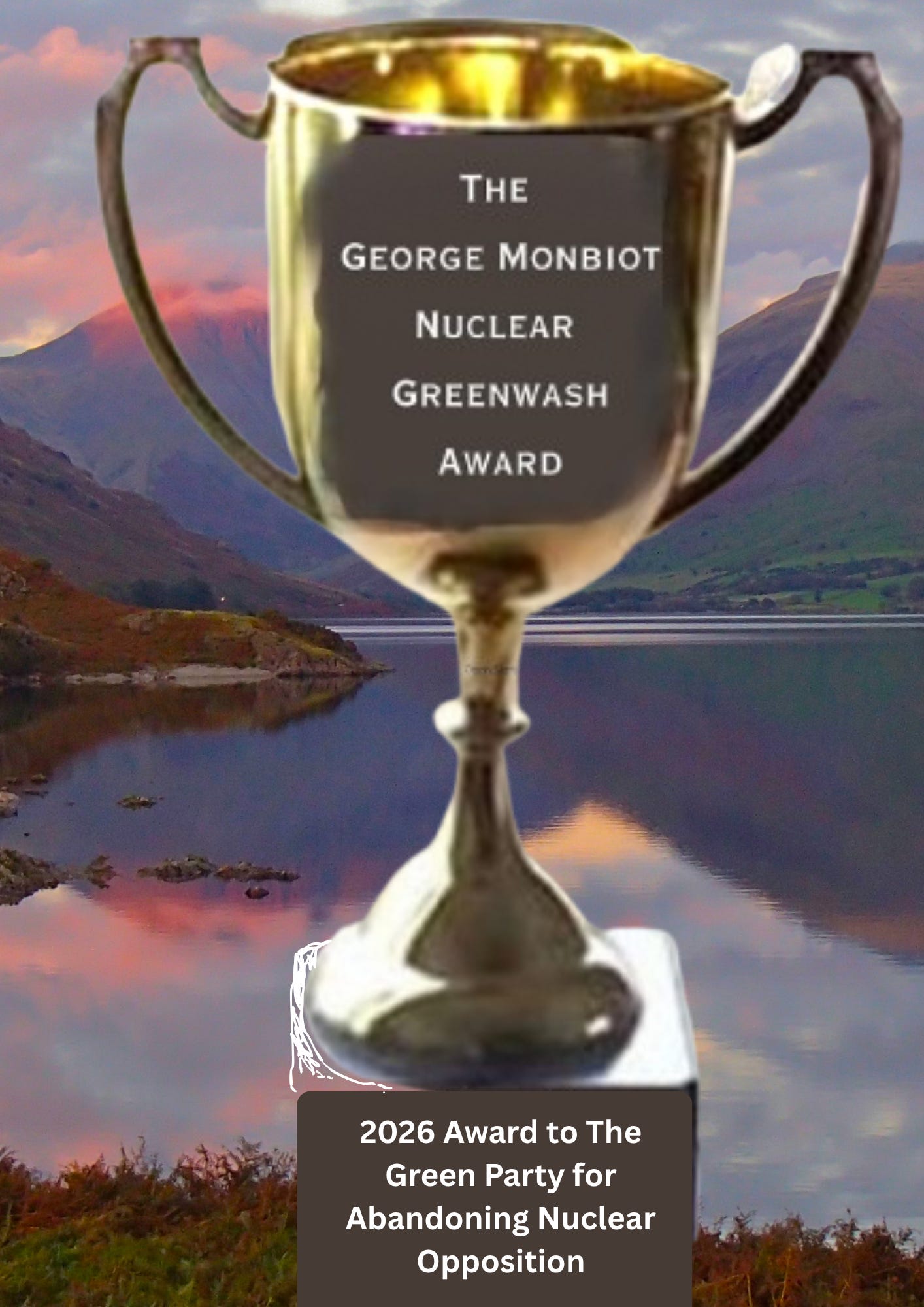
Image: The George Monbiot Nuclear Greenwash 2026 Award to The Green Party for Abandoning Nuclear Opposition. George Monbiot’s famous “I love nuclear” in the wake of the Fukushima disaster deflected an otherwise inevitable crisis of nuclear confidence and was of course key to the push for the building of the first new nuclear plant in the UK in decades at Hinkley C which he now says (after facilitating the damn thing) should be scrapped in favour of, even more dangerous. fast breeder reactors,
Lakes Against Nuclear Dump, Oct 12, 2026, https://lakesagainstnucleardump.com/2026/10/12/2026-george-monbiot-nuclear-greenwash-award-goes-to-the-green-party-for-abandoning-nuclear-opposition/
Just days before the 69th anniversary of the UKs worst nuclear accident to date , the Windscale Fire, the Green Party announced their abandonment of their opposition to nuclear, and with it their reason for being. The Green Party used to call the nuclear industry the “nuclear military industrial complex” for good reason, the “civil” nuclear industry is necessary in order to produce elements for military use, including plutonium, tritium and americium.
Here in Cumbria we won’t notice much difference as the Green Party have spectacularly failed to publicly voice strong opposition or lead any charges against nuclear developments for many years with Green Party members seemingly much more concerned with the horrible nitty gritty of political advancement than protecting the health and wellbeing of the public and our environment from nuclear developments.
Having said that we wait more in hope than expectation to be surprised and delighted by vigorous, strong and principled Cumbrian Green Party opposition to the tsunami of nuclear developments coming our way.
It has not gone unnoticed that despite there being more Green councillors than ever before on Cumberland council, the Council as a whole is like never before, acting as a facilitating arm of the nuclear industry. Cumberland council and its Green Party members are partners in the geological nuclear dump plan and partners in the plan to bring Japanese sodium coolant to Cumbria amongst other things.
Bizarrely the Green Party in Cumbria even had to be persuaded long and hard by Radiation Free Lakeland to oppose the earth quake inducing coal mine near Sellafield with the Green Party’s candidate, in the 2017 Whitehaven hustings Jack Lenox actually saying he was “a big fan of coking coal” this despite its close proximity to Sellafield. The coal mine was finally refused largely on the grounds of induced seismicity.
Professor Chris Busby has this to say: “the Green Party began as an anti-nuclear party in Germany, with Petra Kelly. When I chained myself to the gates of Trawsfynydd Nuclear Power Station in Wales in 1992, Petra Kelly had agreed to come and support our campaign against opening the nuclear site, which was dangerous. The station operators had applied to run the reactors at a high temperature to anneal the cracks in the pressure vessel. This was not long after the experiment at Chernobyl. And the contamination of Wales by Chernobyl (which led to sharp increases in cancer and child leukemia)…..The nuclear police had pistols and we were told they would shoot us. Petra Kelly was assassinated a few months after this. How can I say this? How do I know? Well, of course I don’t know and cannot be sure. But here is something you don’t know about this. The story now widely accepted (look at Wikipedia) is that her man, General Gert Bastiaan killed her.
The police determined that Kelly was shot dead while sleeping by Bastian, who then died of suicide.
Well and Good. But I spoke with Prof Ernest Sternglass about this. He knew both of them, and said it was impossible that Bastiaan would have killed her and himself. They were full of positive energy and life, when he met them in Berlin some 6 weeks before she died. She was very excited. She had received an offer of considerable financial support by German TV to make a series of documentaries with Russian and Belarussian scientists including Dr. Shevchenko, to report on the real health effects of the Chernobyl accident contamination. At the time, the nuclear operators and their tame scientists in the IAEA and the WHO were stating that there were no measurable health effects. It was the same at Fukushima some twenty years later. But back in those days they killed you, rather than using media to destroy your credibility.”
The market is being brutal with nuclear companies that are still years away from making real money

Oil Price By Alex Kimani – Oct 11, 2026
Nuclear energy stocks have suffered heavy losses over the past year, even as technology companies commit billions of dollars to securing nuclear electricity for AI data centers. The Global X Uranium ETF (URA) has lost more than 20% over the past 12 months, compared with gains exceeding 40% for the Energy Select Sector SPDR Fund (XLE). Investors have grown increasingly concerned about valuations, financing requirements and the long development timelines for companies that don’t yet generate any meaningful commercial revenues.
The market has been brutal with nuclear companies that are still years away from making real money. NuScale Power Corp. (NYSE: SMR) has lost about 82% of its value over the past year, Oklo Inc. (NYSE: OKLO) is down roughly 75%, and Nano Nuclear Energy (NASDAQ: NNE) has fallen nearly 68%. All three are developing technologies that could eventually feed enormous new demand for nuclear power, but investors are no longer paying nearly as much for what could happen years from now.
NuScale received standard design approval from the Nuclear Regulatory Commission (NRC) for its 77-megawatt SMR technology in May 2025, but continues to burn cash as it works toward commercial deployment. In January, Sam Altman-backed Oklo and Meta Platforms (NASDAQ: META) announced an agreement supporting development of a 1.2-gigawatt nuclear energy campus in Pike County, Ohio, to supply electricity for Meta’s regional data centers and AI infrastructure. Initial generation is targeted for as early as 2030, with the full 1.2 GW potentially coming online by 2034. Nano Nuclear, which is developing portable microreactors, also faces a long road to commercialization.
Uranium fuel suppliers and miners have suffered substantial losses of their own. Centrus Energy Corp. (NYSE: LEU) has dropped some 62% over the past year, Uranium Energy Corp. (NYSE American: UEC) has fallen roughly 32%, and BWX Technologies (NYSE: BWXT) has lost around 27%………………………….https://oilprice.com/Alternative-Energy/Nuclear-Power/3-Stocks-To-Play-The-Nuclear-Energy-Boom.html
A Shadow of Fear Hangs Over Gazans Amid Israeli Defense Minister’s Threats

October 11, 2026 By Dalia Abu Ramadan, https://scheerpost.com/2026/10/11/a-shadow-of-fear-hangs-over-gazans-amid-israeli-defense-ministers-threats/
This article was originally published by Truthout
Israel Katz says Israel will forcibly displace 1 million Gazans if “even one Israeli soldier” is abducted.
We are about to close out three years and enter another since Israel invaded Gaza, but we are not leaving the war behind to begin a new life. We are entering yet another year without knowing when this war will end — or whether it will end at all.
The fear remains. The destruction remains. The threats remain. It feels as though each passing year does not bring us closer to an end, but closer to the possibility of another war.
Despite everything we are living through in Gaza, we understand what it means to live one day at a time — to hold on to every simple moment we can still have. Imagine planning for another morning, perhaps for the simplest of things: going out with the friends you still have, or taking your family to the sea in the morning, amid all this destruction, simply to experience a moment that feels like life.
Then, as you are planning that ordinary morning, you hear a statement from Israeli Defense Minister Israel Katz, who said on September 22: “If even one Israeli soldier or civilian is abducted, the city of Gaza — with its homes and terrorist towers — will be evacuated southward of its one million residents.”
Words like these are enough not only to disrupt your day, but to shake your entire future. The first question we asked ourselves was: Where would we go? Is there anywhere left for us to go?
“Everyone is talking about how the possibility of an Israeli soldier being captured has become impossible, that it will not happen, and that it could be an excuse to provoke people in Gaza and pave the way for the war to return,” Haneen Salem, a photographer in Gaza City, told me. “I am certain something will happen. No one knows what, but there is a shadow of fear hanging over Gaza’s civilians.”
Even my father said, “Expect it to happen at any moment,” warning that we could be forcibly displaced yet again, especially because we are living through another difficult period in Gaza. The intensity of Israeli bombardment had increased in the weeks leading up to Katz’s statement, and warplanes had not stopped flying overhead at night.
We are being asked to imagine another war while we are still living inside the aftermath of the one that was supposed to have ended.
The so-called ceasefire took effect at noon local time on October 10, 2025. A year has passed since that announcement, but the war has not ended. It is true that the intensity of the escalation and displacement has eased compared to the height of Israel’s war, but the bombardment and destruction have continued. So, what does it mean to hear threats of the war returning with the same ferocity when we have not even begun to recover from what has already happened?
When the “ceasefire” was announced, I believed the war would end as the wars of 2021, 2014, and previous years had ended — with a clear conclusion, a moment when we would know that the war was truly over. I expected that, immediately after the announcement, we would begin clearing the rubble, rebuilding what had been destroyed and slowly putting our lives back together.
But that did not happen.
Instead, it felt as though the war continued in another form, behind the scenes — a reality visible only to the people of Gaza who have been living through its consequences every day. Today, we still have not recovered. Even the most basic medical necessities remain unavailable, the siege is tightening, and the consequences of the war continue to surround every part of our lives.
The collapse of the Al-Sadah building in Tal al-Hawa is one example of what this unfinished recovery looks like. The building had been home to approximately 80 displaced Palestinians. In the early hours of September 16, it collapsed, with parts of the structure also falling onto nearby buildings and tents that were sheltering other displaced families. Rescue teams initially estimated that around 100 people, including at least 50 children, were trapped beneath the rubble. After rescue operations ended, Civil Defense teams confirmed that 21 people had been killed, including 12 children and five women, while 45 injured people were taken to hospitals.
With rubble left uncleared and too little being done to address the dangers left behind by the destruction, many partially damaged buildings across Gaza have been left standing in a fragile state, at risk of collapsing at any moment.
The Al-Sadah building had sustained structural damage from Israeli bombardment during the war and was struck several times in 2024 and again in March 2025. Civil defense teams had warned residents not to return to the building. Yet some had no other choice but to live there. With tents and homes unavailable, displaced Palestinians have been forced to shelter in cracked and damaged buildings, despite the risk that they could collapse around them.
But the danger does not end when people are pulled from the rubble. Those who survive still face a health system struggling to meet even the most basic needs. As World Health Organization Director-General Tedros Adhanom Ghebreyesus said on September 24, “Essential medicines, diagnostics, equipment and fuel remain in critically short supply.”
These shortages are not limited to life-saving medicines and hospital equipment; they reach into the most ordinary forms of care, turning even a visit to the dentist into a struggle.
It may be one of the most basic forms of health care, but anyone who has experienced severe tooth pain knows how unbearable it can be — especially as poor nutrition and the effects of prolonged hunger have taken a toll on people’s dental health.
“Getting dental supplies and materials into Gaza has become extremely difficult,” dentist Dr. Ghalib Zimmo told me. “And when they do enter, they are prohibitively expensive. The cost of dental materials has risen to 10 times what it was before the war.”
The consequences are painful. “Many patients come to us needing root canal treatment, which can involve unbearable pain,” Dr. Ghalib said. “But because of the cost, they choose to have the tooth extracted instead of treating it.”
“Before the war, a root canal cost around $40,” he explained. “Now, it can cost as much as $250.”
Imagine how deeply exhausted we have become. We search for medicine, and it is not there. We search for wheelchairs for those who have lost limbs in the war, and they are not there. We search for the simplest things that make life possible, and they are not there.
Fear has become part of the way we respond to every sound. Sometimes, when we hear a sudden noise, we immediately think it is the sound of a missile just before it strikes. We can even find ourselves startled by the sound of a chair moving.
We are living with a trauma that no one can truly feel the way we do. Three years of relentless bombardment have left their mark on us. We search for life itself, and we cannot find it.
1 This Month
23-25 October – on Zoom – World BEYOND War’s annual global conferenc

To see nuclear-related stories in greater depth and intensity – go to https://nuclearinformation.wordpress.com

Say No to NASA’s Reckless Nuclear Reactor on the Moon
Say No to NASA’s Reckless Nuclear Reactor on the Moon
-
Archives
- October 2026 (160)
- September 2026 (339)
- August 2026 (330)
- July 2026 (355)
- June 2026 (287)
- May 2026 (306)
- April 2026 (356)
- March 2026 (251)
- February 2026 (267)
- January 2026 (308)
- December 2025 (358)
- November 2025 (359)
-
Categories
- 1
- 1 NUCLEAR ISSUES
- business and costs
- climate change
- culture and arts
- ENERGY
- environment
- health
- history
- indigenous issues
- Legal
- marketing of nuclear
- media
- opposition to nuclear
- PERSONAL STORIES
- politics
- politics international
- Religion and ethics
- safety
- secrets,lies and civil liberties
- spinbuster
- technology
- Uranium
- wastes
- weapons and war
- Women
- 2 WORLD
- ACTION
- AFRICA
- Atrocities
- AUSTRALIA
- Christina's notes
- Christina's themes
- culture and arts
- Events
- Fuk 2022
- Fuk 2023
- Fukushima 2017
- Fukushima 2018
- fukushima 2019
- Fukushima 2020
- Fukushima 2021
- general
- global warming
- Humour (God we need it)
- Nuclear
- RARE EARTHS
- Reference
- resources – print
- Resources -audiovicual
- Weekly Newsletter
- World
- World Nuclear
- YouTube
-
RSS
Entries RSS
Comments RSS

